
New to solar terminology?
Use the Solar Glossary for plain-English definitions of kW, kWh, solar offset, net metering, net billing, inverter clipping, cost per watt, battery capacity and other terms used throughout the site.
Compare ownership and financing with 2026 rules
Start with the cash-equivalent project price, then identify whether the proposal is cash, a loan, a lease or a PPA. For loans, compare financed principal, APR, term, dealer fees and total payments. For leases and PPAs, review the payment or energy-rate schedule, escalation, transfer/buyout rules and total contract obligation instead of forcing the agreement through loan math.
Go from outage questions to a realistic multi-day battery plan
Start by understanding what actually happens to rooftop solar when the grid fails. Then estimate the loads you need to keep running, separate stored energy from discharge, surge and charging power, check solar recharge constraints, stress-test the same system across three changing solar days, verify the written battery quote, and finally compare installer packages on the same basis.

Solar Battery Backup Runtime Calculator
Model battery-only runtime, starting SOC, continuous-power fit, motor-start surge, load shedding, pre-solar survival and solar recharge-window limits with shareable scenarios.
Open outage planner →Home Battery Quote Checklist
Review 15 battery, power, installation-scope and warranty items, track what the written proposal has actually confirmed and copy the remaining verification questions before comparing installer packages.
Open the 15-item checklist →How to Compare Home Battery Quotes
Normalize installer storage packages by usable kWh, then compare discharge power, charging limits, surge, gateway/controller scope, warranties and the exact work included before treating two quotes as equivalent.
Read the battery quote comparison guide →Battery Charge Power vs Discharge Power
Separate usable kWh, continuous discharge kW, short motor-start surge and charging kW so one headline battery rating does not hide a different outage constraint.
Understand the four battery limits →How Fast Can a Home Battery Recharge From Solar?
See why solar surplus, backed-up household load, battery charge-power limits, efficiency and the effective solar window all affect how quickly storage can recover after an outage.
Open recharge-speed guide →3-Day Solar Battery Outage Calculator
Follow battery state of charge across 72 hours, change the solar assumption for each day and screen the minimum number of full battery units that survives the selected weather sequence.
Run the 72-hour simulation →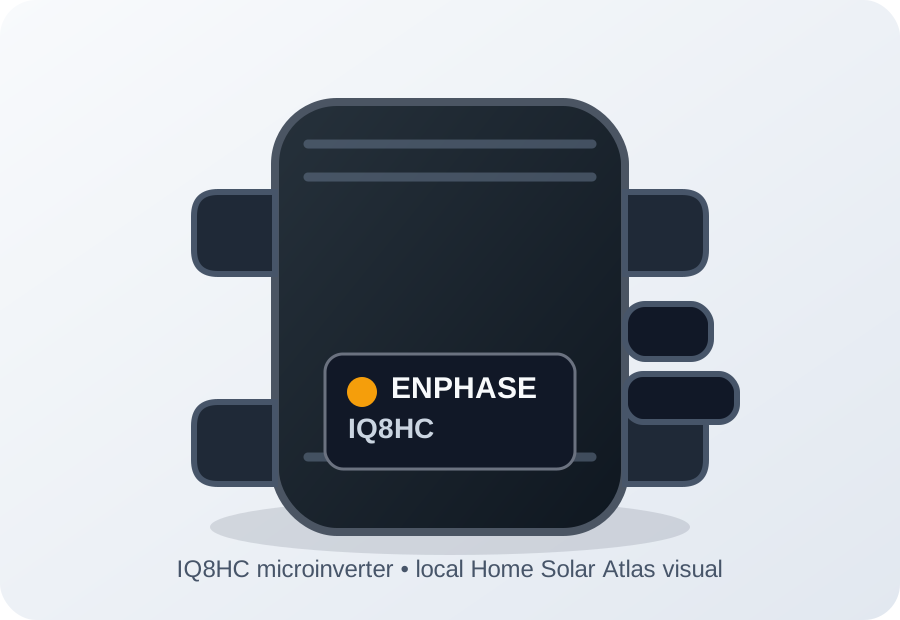
Microinverter vs String Inverter vs Optimizer
See three real inverter products, simplified energy-flow diagrams and the homeowner tradeoffs behind module-level microinverters, optimizer systems and central string or hybrid inverters.
Open visual inverter guide →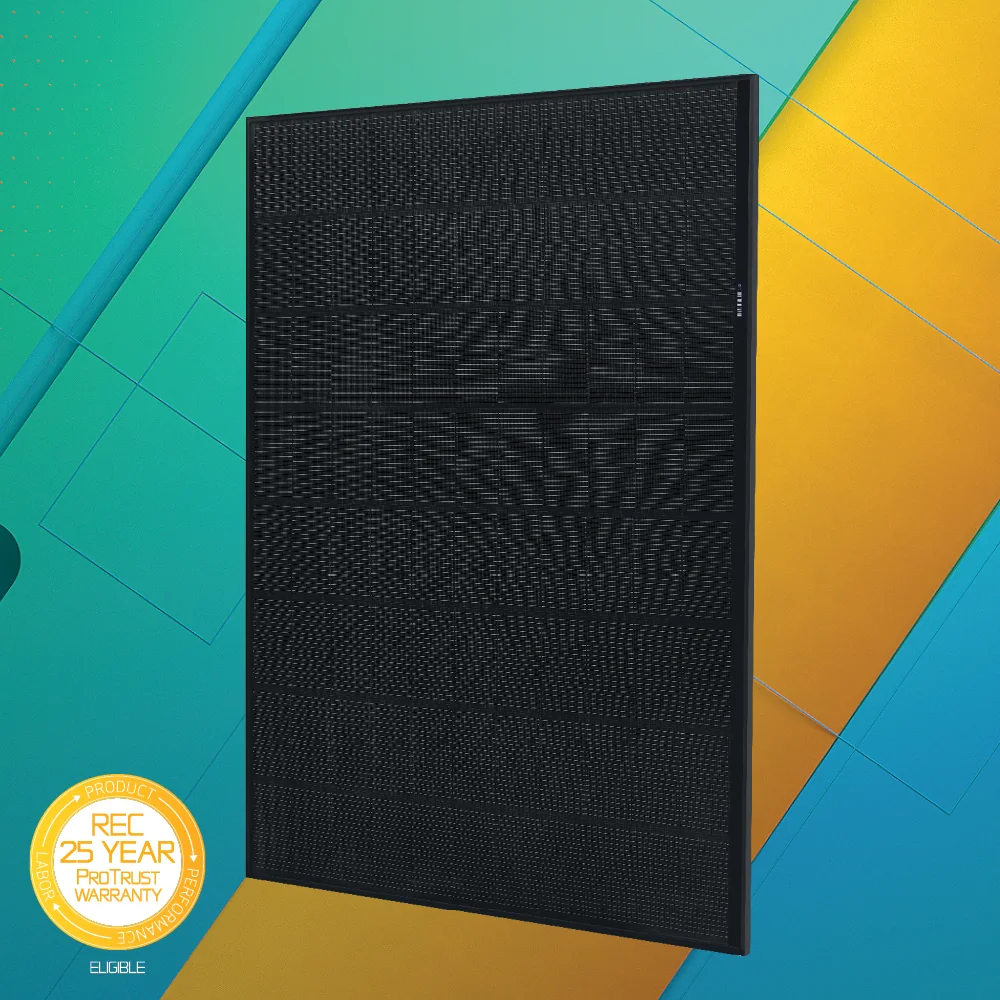
HJT vs TOPCon Solar Panels
See real REC, Qcells and Silfab modules, simplified cell-layer diagrams and why HJT and TOPCon can both be monocrystalline technologies.
Open visual panel technology guide →5 kWh vs 13.5 kWh vs 15 kWh Home Batteries
Compare real home batteries with capacity bars, kWh-vs-kW context and simplified runtime examples for light, moderate and heavy backup loads.
Open visual battery capacity guide →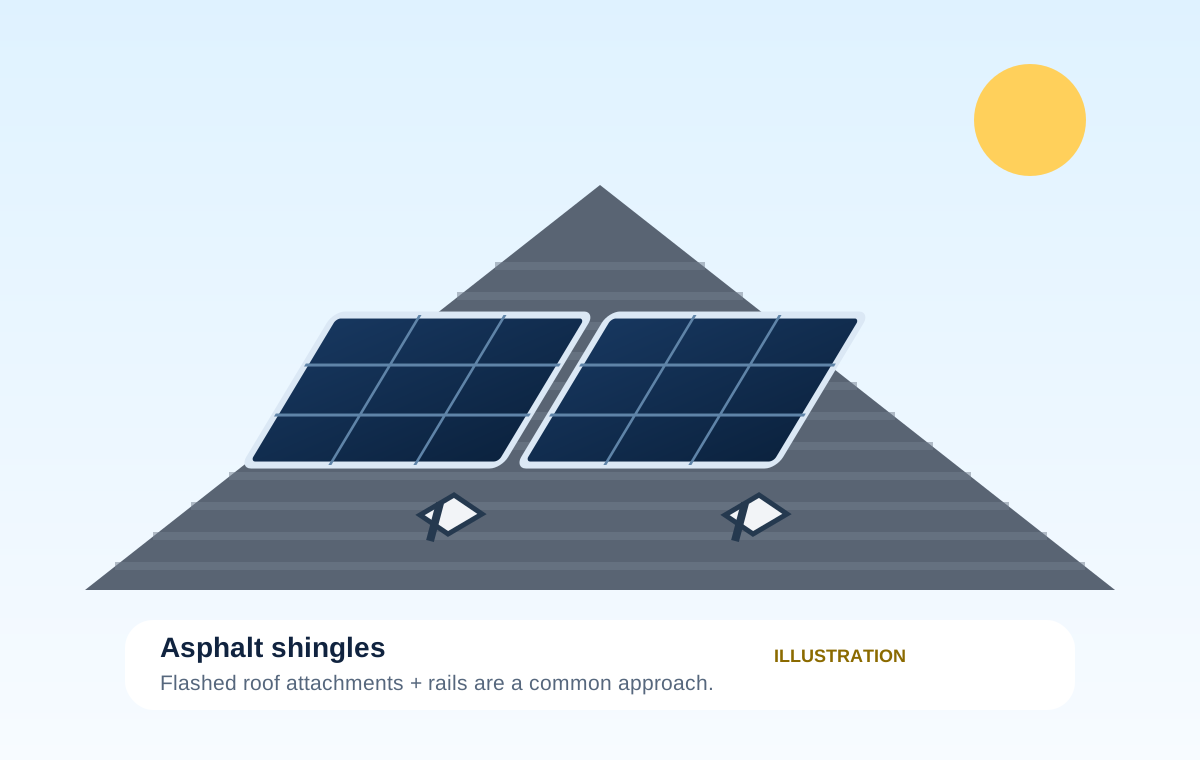
Best Roof Types for Solar Panels
Compare asphalt shingles, standing-seam metal, tile and flat roofs with mounting diagrams, roof-specific risks and planning questions.
Open visual roof guide →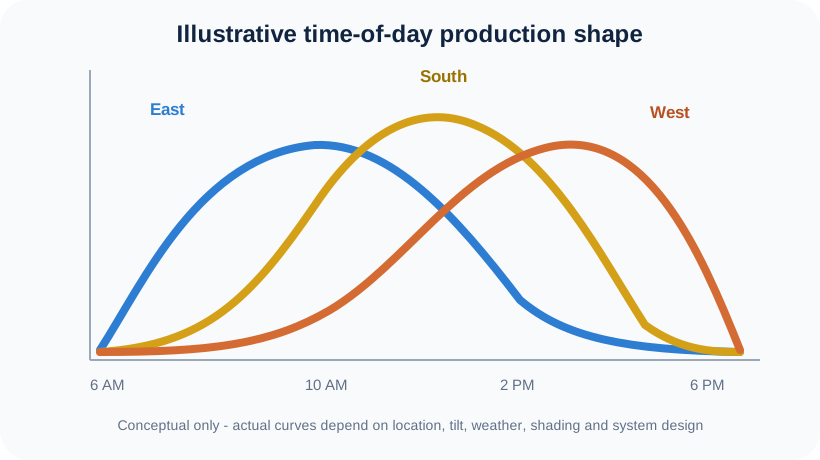
South vs East vs West Facing Solar
See how roof azimuth changes annual production and when solar energy arrives during the day, including the homeowner implications of time-of-use rates.
Open visual orientation guide →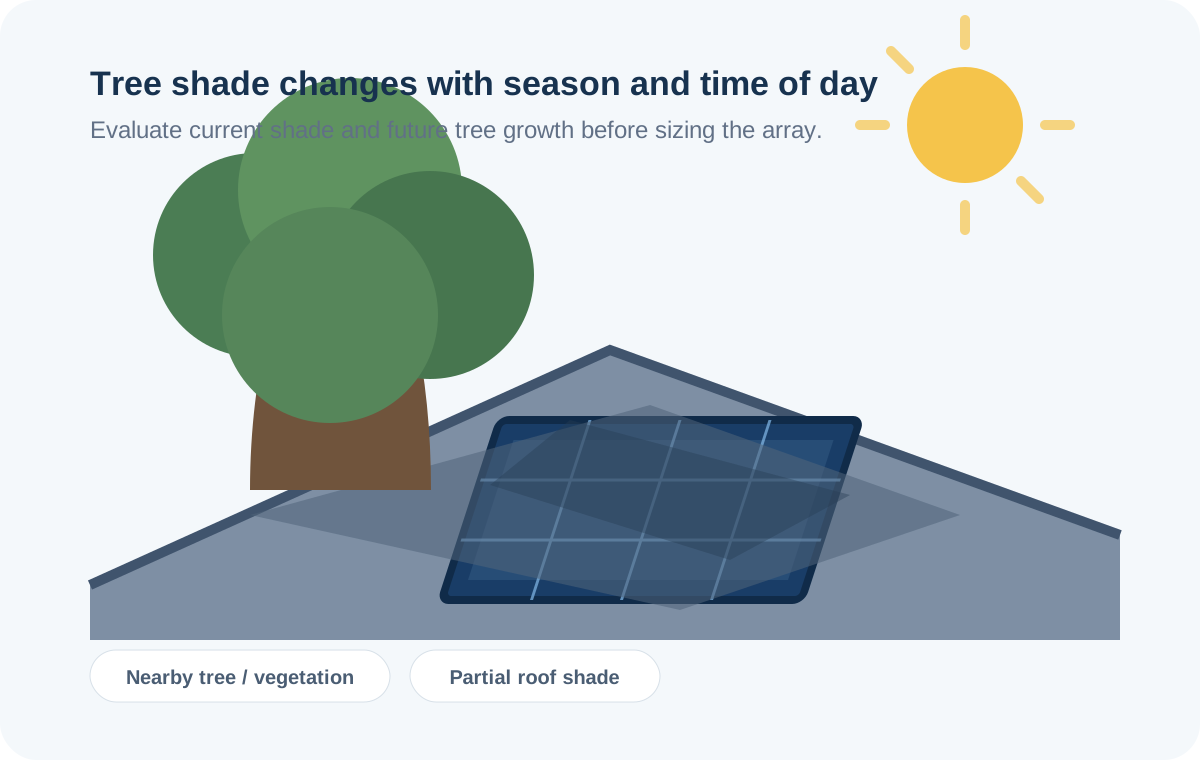
Solar Shading: Trees, Chimneys & Partial Shade
See how trees, chimneys, dormers and nearby structures can change solar production, roof layout and the right way to model a shaded roof.
Open visual shading guide →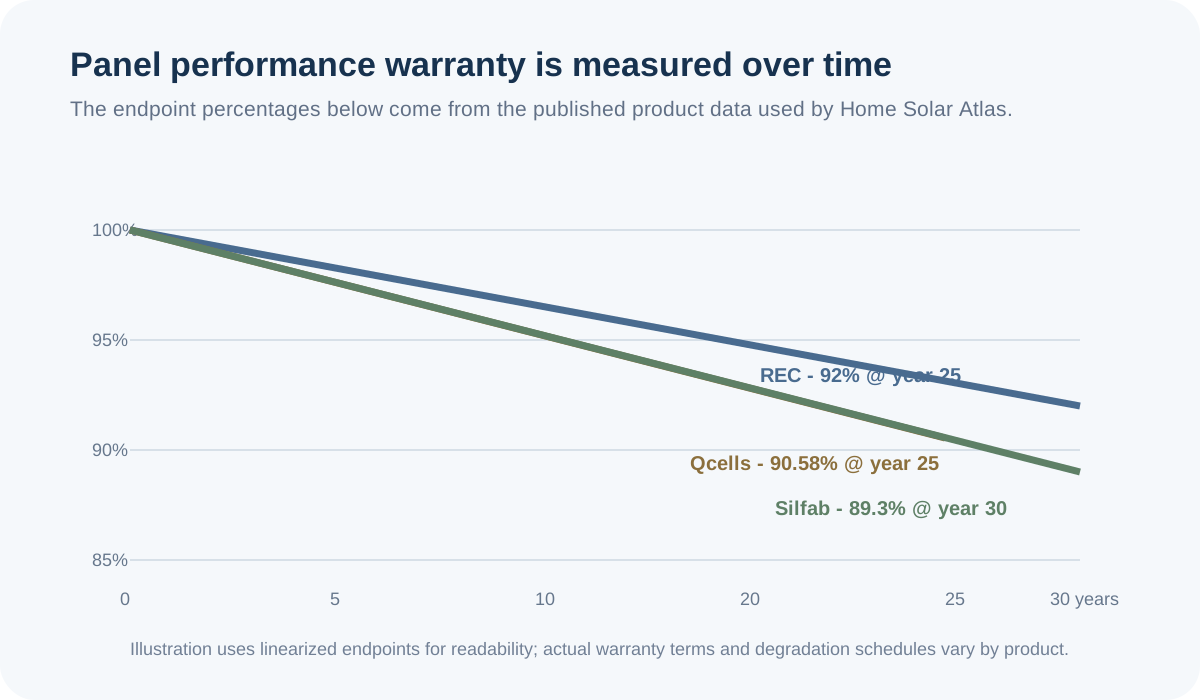
Solar Panel Degradation & Warranties
Understand product vs performance warranties and compare published long-term power endpoints for current REC, Qcells and Silfab residential panels.
Open visual degradation guide →Cash vs Solar Loan in 2026: Which Costs Less?
Compare a cash solar purchase with a solar loan in 2026 using cash-equivalent price, financed principal, dealer fees, APR, loan term, total payments and current federal homeowner-credit timing.
Last reviewed 2026-08-31Read guide →Solar Loan Dealer Fees in 2026: Cash Price vs Financed Principal
Understand solar loan dealer and program fees, why financed principal can exceed the cash price, how to calculate a loan premium and why APR or monthly payment alone is not enough.
Last reviewed 2026-08-31Read guide →Solar Lease vs PPA: What Is the Difference?
Compare solar leases and power purchase agreements by payment structure, ownership, escalation, maintenance, transfer rules and end-of-term options.
Last reviewed 2026-08-28Read guide →Solar Loan Re-Amortization and Payment Step-Ups in 2026
Understand solar-loan re-amortization, expected early principal payments and payment step-ups in 2026 without assuming a new residential project will receive the expired Section 25D homeowner credit.
Last reviewed 2026-08-31Read guide →Selling a Home With Solar: Loan, Lease and PPA Checklist
Prepare a solar-equipped home for sale by identifying system ownership, loan payoff, lease or PPA transfer requirements, warranties, monitoring records and production history.
Last reviewed 2026-08-28Read guide →Solar Proposal Red Flags: What to Verify Before You Sign
Review the most important warning signs in a residential solar proposal, from system-size arithmetic and production claims to financing, escalators, equipment, warranties and export limits.
Last reviewed 2026-09-16Read guide →Do Solar Panels Work During a Power Outage?
Learn why most grid-tied solar systems shut down during an outage, when a battery can keep selected loads running and what backup questions to ask before installation.
Last reviewed 2026-08-28Read guide →Is a Solar Battery Worth It? A Homeowner Decision Guide
Evaluate a home battery for outage backup, time-of-use savings, low export compensation and solar self-consumption instead of judging it by one national payback number.
Last reviewed 2026-08-28Read guide →Battery Charge Power vs Discharge Power: Why Both kW Ratings Matter
Understand the difference between home-battery charging power, continuous discharge power, surge power and usable kWh, and why all four can affect solar backup performance.
Last reviewed 2026-08-30Read guide →Should You Replace Your Roof Before Installing Solar?
Use roof age, condition, remaining life and removal-and-reinstall risk to decide whether roofing work should happen before a new solar installation.
Last reviewed 2026-08-28Read guide →Solar Panel Maintenance: What Homeowners Actually Need
A practical residential solar maintenance checklist covering monitoring, inspections, cleaning, vegetation, inverters and post-storm checks without unnecessary service claims.
Last reviewed 2026-08-28Read guide →Solar Warranties Explained: Panels, Inverters, Batteries and Workmanship
Understand the separate warranties behind a home solar project and the questions that reveal whether parts, labor, roof penetrations and service are actually covered.
Last reviewed 2026-08-28Read guide →Is Solar Worth It in 2026? A Homeowner Decision Framework
Evaluate solar in 2026 using electricity prices, roof production, local incentives, export rules, system cost and payback instead of outdated national rules of thumb.
Last reviewed 2026-08-27Read guide →How to Read a Solar Quote Before You Sign
A homeowner checklist for comparing solar quotes by system size, cash-equivalent price, equipment, production, financing, warranties and utility assumptions.
Last reviewed 2026-08-27Read guide →Cash vs Solar Loan vs Lease vs PPA in 2026
Compare cash, solar loans, leases and PPAs in 2026 using ownership, cash-equivalent price, dealer fees, APR, contract escalation, transfer rules and the current federal homeowner tax-credit rules.
Last reviewed 2026-08-31Read guide →How to Size a Home Solar System
Size residential solar from annual electricity consumption, local solar yield, roof constraints, future EV or heat-pump loads and desired energy offset.
Last reviewed 2026-08-27Read guide →How Many Solar Panels Do I Need?
Estimate residential solar panel count from annual electricity use, local solar yield, desired offset and panel wattage instead of guessing from home size.
Last reviewed 2026-08-27Read guide →Solar kW vs kWh: What Homeowners Need to Know
Understand the difference between solar system power in kW and energy production in kWh, and why confusing the two can make quotes and savings estimates hard to compare.
Last reviewed 2026-08-27Read guide →Solar Panel Efficiency Explained
Learn what solar panel efficiency means, when higher efficiency matters and why efficiency alone does not determine total home-solar production or value.
Last reviewed 2026-08-27Read guide →Solar Roof Orientation and Tilt Explained
Understand how roof direction, azimuth and tilt affect residential solar production and when east-, west- or south-facing arrays can make sense.
Last reviewed 2026-08-27Read guide →Home Battery kW vs kWh: Capacity and Power Explained
Understand the difference between home-battery storage capacity in kWh and output power in kW before comparing backup systems.
Last reviewed 2026-08-27Read guide →