
The two warranties answer different questions
Product warranty: protects against specified defects or failures in the panel itself. Its duration can vary significantly by manufacturer and product.
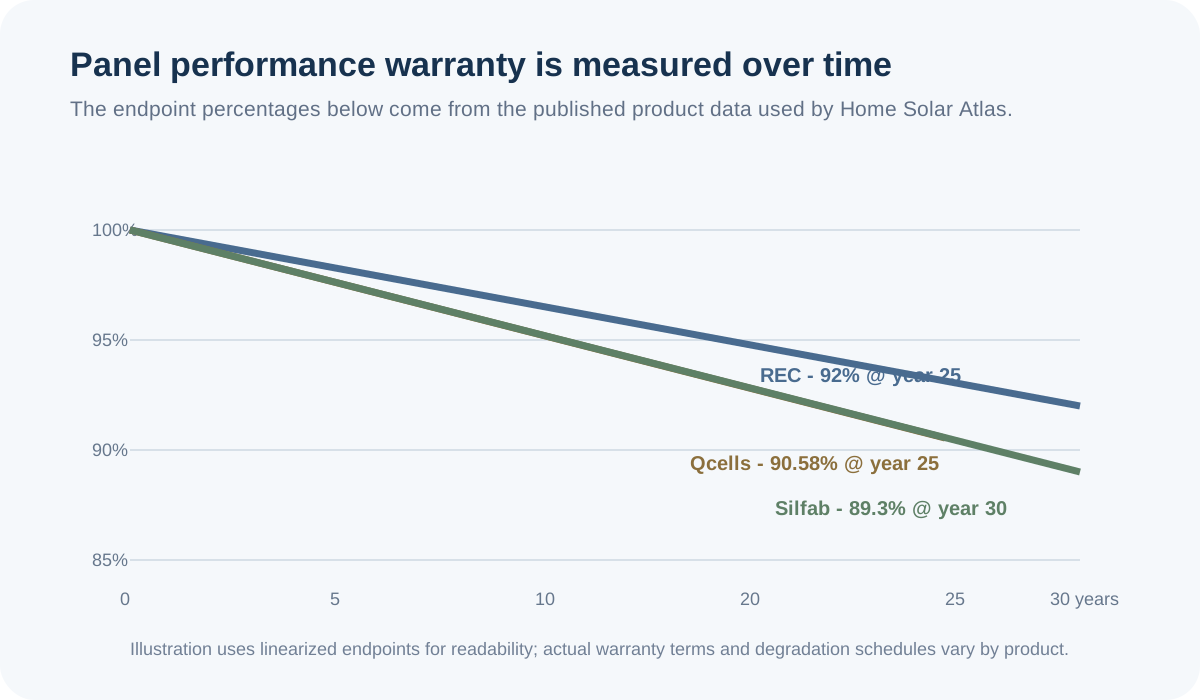
Performance warranty: promises that the module will retain at least a specified percentage of its original power under the warranty terms after a defined number of years.
For a homeowner comparing panels, neither number should be viewed in isolation. A long performance warranty does not automatically mean a panel is the best value, and a product warranty does not tell you how much energy the module is expected to produce after 20 or 30 years.
REC Alpha Pure-RX
Product: 20 years standard; 25 years with eligible REC ProTrust
Performance: 25 years
Qcells Q.TRON BLK M-G2+
Product: 25 years
Performance: 25 years
Silfab SIL-440 QD
Product: 12 years standard; extendable to 25 years subject to registration and conditions
Performance: 30-year linear power performance guarantee
| Panel | Power | Efficiency | Cell technology | Product warranty | Performance endpoint |
|---|---|---|---|---|---|
| REC Alpha Pure-RX | 450-470 W | 22.6% | HJT (heterojunction) | 20 years standard; 25 years with eligible REC ProTrust | 92% minimum power in year 25 |
| Qcells Q.TRON BLK M-G2+ | 415-440 W | 22.5% | N-type TOPCon / Q.ANTUM NEO | 25 years | At least 90.58% nominal power at year 25 |
| Silfab SIL-440 QD | 440 W | 22.6% | N-type silicon | 12 years standard; extendable to 25 years subject to registration and conditions | 89.3% minimum at year 30 |
Why a small annual degradation rate matters
Degradation compounds over a long ownership period. For example, a module that loses roughly 0.25% of its warranted power each year after its first year retains about 94% after 25 years under a simple compounded model. A module with a 0.50% annual rate would retain about 88% over the same simplified period.
Those calculations are useful for intuition, but they are not a substitute for the manufacturer's actual warranty schedule. Warranty language can use a first-year step-down followed by a different annual rate, so compare the published endpoint and schedule rather than relying on one generic degradation formula.
Model two degradation-rate scenarios from the same Year 1 production →
What does 92% after 25 years actually mean?
If a panel's warranted endpoint is 92% of nominal power at year 25, a 470 W module would have a warranted power floor of roughly 432 W at that endpoint: 470 × 0.92 = 432.4 W.
That does not mean every panel will produce exactly 432 W in year 25, nor does it describe annual household energy production. Temperature, irradiance, orientation, soiling, shading, inverter losses and many other factors affect actual energy yield.
A 30-year warranty can be useful when the rest of the system is built to last
Silfab's published SIL-440 QD data includes a 30-year linear power performance guarantee with a 89.3% minimum at year 30. That longer horizon can be relevant to homeowners planning long-term ownership, but it should be compared with the panel's installed price, expected production, installer workmanship warranty, inverter warranty and roof condition.
This is also why a panel's warranty should not be treated as a standalone ranking. A lower degradation endpoint can matter financially, but the additional lifetime energy only has value if the system remains well maintained and the energy is worth producing under the home's utility rate structure.
Five warranty questions to ask before buying
- How many years does the standard product warranty cover?
- Is a longer warranty conditional on registration, installer status or another program?
- What is the first-year degradation allowance?
- What percentage of nominal power is guaranteed at year 25 or year 30?
- Who handles a warranty claim if the manufacturer or installer is no longer available?
How this fits into your solar decision
Manufacturer sources
Product specifications are time-sensitive. Home Solar Atlas records a verification date for the equipment data and recommends checking the current manufacturer warranty document before purchase.